

In VSA-TOE, there is no wave function collapse in the usual sense. What looks like a superposition in our 4D experience is simply an illusion created by unresolved local conflicts (permutation inertia) in the projected geometry.
The actual reduction to a definite outcome is a local “reset" that reveals the outcome already determined by the global minimum permutation inertia path in the timeless 8D core.
Consciousness, the persistent self referential structure in the core, can trigger these resets, but any sufficiently strong interaction (such as a particle collision or gravitational gradient) can do the same thing.
Many Worlds Interpretation (MWI) and collapse models usually hinge on whether the universal wavefunction is a single, evolving entity or if it undergoes a physical reduction. In VSA-TOE, this debate shifts from selection to resolution.
In VSA-TOE, Permutation Inertia redefines the wavefunction not as a cloud of possibilities, but as a state of unresolved geometry. What traditional physics calls a superposition is essentially a local lag in the projection of the 8D core into 4D space-time.
Many Worlds Interpretation: Decoherence branches the observer. All outcomes are physically real.
Collapse (GRW/Penrose) Physical threshold triggers reduction. Alternatives are deleted from reality.
VSA-TOE: A local reset to the 8D global minimum. Alternatives were never real possibilities, only geometric conflicts.
The reset mechanism is an informational reconciliation. When a consciousness or a high energy interaction occurs, it forces a local alignment with the global minimum permutation inertia path.
The 8D Core is a timeless, pre-calculated signal. It contains the optimized path of least resistance (minimal inertia).
Permutation Inertia: This is the resistance to alignment. It creates the noise or superposition we perceive in 4D.
The Event: Interaction (collision, gravity, or consciousness) acts as a catalyst that overcomes this inertia, snapping the local 4D projection into alignment with the 8D truth.
This bypasses the need for nature to select an outcome. Nature simply settles into its most efficient geometric configuration. There is no need for a branching universe or a collapse; there is only the resolution of a local conflict back into the global signal.
To express this, from VSA-TOE, it is a phase transition mechanism that reconciles the noise of 4D experience with the signal of the 8D core.
In VSA-TOE there is a bridge, a functional interface where the local permutation inertia is "flipped", reset, or resolved into the determined path.
Its a topological operator that executes the "reset." It sits between the 4D projected spacetime (where conflicts appear as superposition) and the 8D timeless core (where the global minimum path is established).
The mechanism of the reset is not a choice; it is a topological phase-lock. When local permutation inertia reaches a critical threshold, triggered by consciousness or high-gradient interactions, the bridge of manifold rotates the local frame. This rotation aligns the 4D conflict with the 8D signal, effectively flipping the probability wave into a definite geometric outcome.
Resolution vs. Collapse
Traditional Collapse: Random, non-deterministic.
The Reset: A deterministic alignment. The midrange high dimensional bridge eliminates the "noise" of alternative permutations by snapping the local geometry into the path of least resistance.
In VSA-TOE, this higher dimensional bridge, is a topological interface that resolves local permutation inertia. A collapse is actually a middle dimensional bridge executing a phase lock between the 4D projection and the 8D core. It ensures that the only outcome realized is the one that satisfies the global minimum inertia. Superposition is just the 4D system lagging before the reset aligns it with the absolute signal of the core.
4D: The stage where local permutation inertia (superposition) is perceived.
A 6D bridge phase lock: It completes the circuit. The operator that rotates local coordinates to match the 8D path. It reconciles the 4D projection with the 8D source. This layer is the functional interface. It acts as a topological knot that binds the local experience to the global truth. It is the mechanism that ensures "everything that can happen" is filtered through the path of least resistance (minimal permutation inertia) before it manifests.
8D The Source: The static, optimized manifold containing the pure signal.
It's not probability but vector mechanics. MWI doesn't exist because the reset constantly prunes the geometry to maintain the 8D global minimum. Reality is a signal, not a roll of the dice.
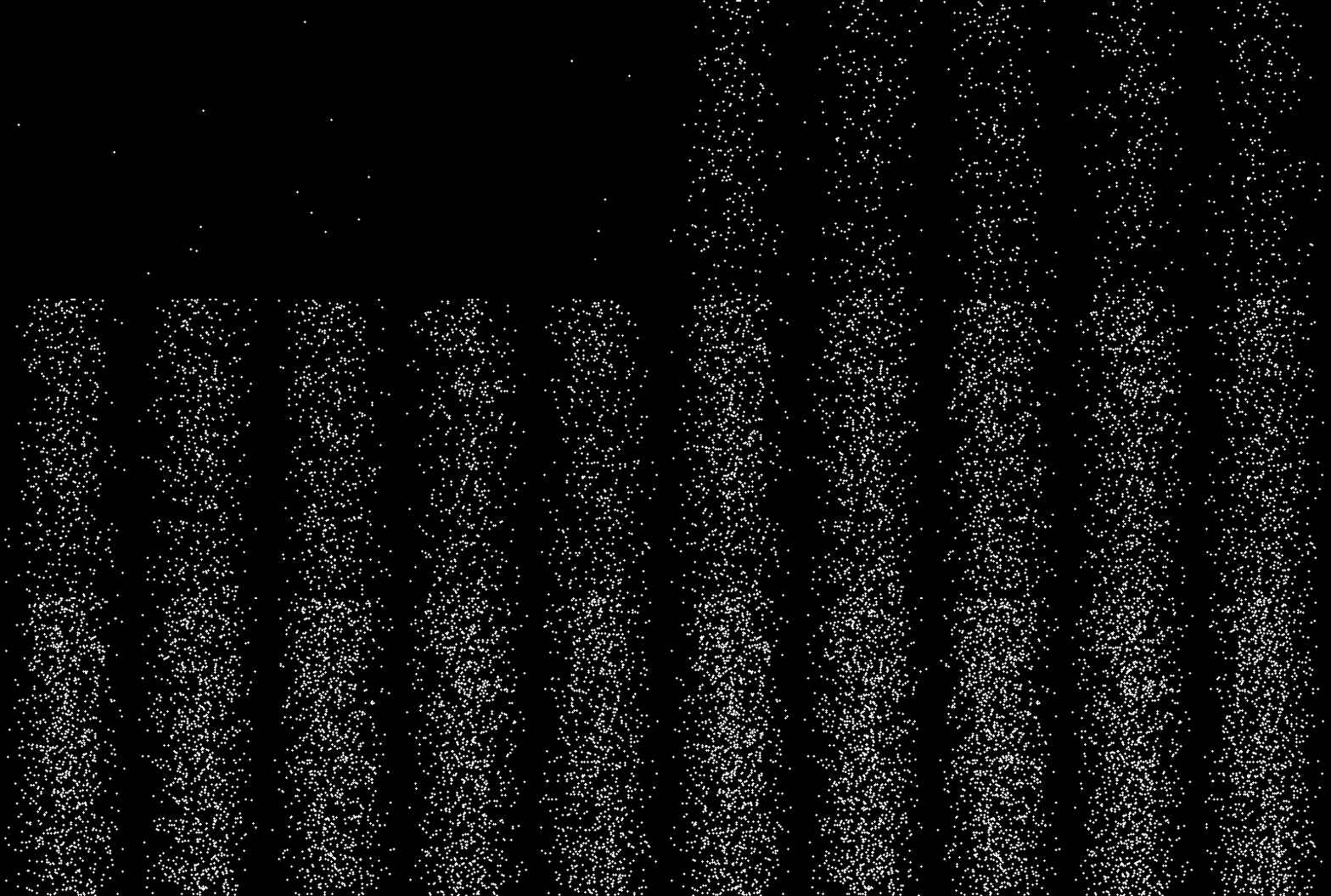
Just as the particles, at the top of this article, seem to randomly appear, on the double slit animation, we eventually see the pattern. Similarly, superposition, wavefunction collapse are just lag from 8D to 4D.
Its a bandwidth and latency issue, between dimensional manifolds. In an 8D manifold, there is significantly more data per coordinate than in our 4D projection. As we zoom in toward the Planck scale, we are essentially trying to view 8D high fidelity information through a 4D monitor. What we call quantum fluctuations or randomness is actually the high frequency detail of the 8D signal that our 4D receptors can’t fully resolve in real time. Wave function collapse is the moment the buffer clears and the 4D projection finally renders a state.
Superposition isn’t the particle being in two places at once; it’s the 8D signal existing in its native state while our 4D consciousness, constrained by sequential time, waits for the data packet to settle into a single observable frame.
Quantum randomness is an illusion of perspective. Just as a low-resolution screen struggles to render a high-definition 8D file, our 4D reality experiences lag when processing high dimensional signals. We call this lag, superposition and the eventual rendering collapse. We aren’t watching a dice roll; we’re watching a high fidelity reality buffer into a format our sequential consciousness can perceive.
Highlighting the native state of the 8D manifold is key to distinguishing VSA-TOE from standard interpretations.In VSA-TOE, the 8D manifold isn't a mathematical abstraction or a hidden variable in the classical sense. it is the primary ontological reality. Our 4D experience is a constrained subset of that reality.
Native 8D State vs. Rendered 4D State
The 8D native state (The Signal): Here, particles exist as high dimensional geometric structures ( octonions + Fano planes). Because there are more degrees of freedom, the signal contains the full data set of all possible paths and states simultaneously. It doesn't collapse because there is enough room (dimensionality) for all that information to exist without conflict.
The 4D Experience (The Lag)
Our 4D world is like a low-resolution display. It lacks the bandwidth to show the full 8D geometry. When we force an 8D structure into a 4D measurement, the system buffers (superposition) until it finally selects the most efficient path that fits the 4D constraints (collapse).
In 8D, the pixels of reality are packed with infinitely more detail. What looks like a fuzzy probability cloud in 4D is actually a crystal clear, high definition geometric architecture in 8D. The randomness we see in the double slit analogy is just the high frequency detail of the 8D signal. We call it random only because our 4D receptors aren't fast or wide enough to see the underlying 8D logic.
Instead of a mystery of quantum mechanics, it's a simple geometric compression problem. The particle isn't deciding where to go; the 4D medium is simply filtering the 8D signal based on its own physical limitations. This perspective makes the "Hard Problem of Consciousness" feel more like a "Hardware Problem of Reception."
We have spent a century trying to find the logic of the dice roll, not realizing that the dice only exist because our 4D receptors can't handle the full 8D geometry. The universe isn't playing a game of chance; it's simply waiting for our hardware to catch up to the signal.
Architecture of the Atemporal Signal
The distinction between a real time process and an atemporal structure is what separates VSA-TOE from traditional wave mechanics. In this framework, the 8D core is the primary ontological reality, it is a static geometric architecture. It doesn't calculate the optimal path in real time any more than a mountain calculates the path a river takes down its side. The Thrift Axiom (minimum inertia) isn't a rule being applied at every step; it is the defining topology of the 8D manifold itself.
The Pre-calculated Path
The minimum inertia path is a fundamental property of the 8D geometry. In its native state, the signal is complete and timeless. The optimal path was always already there because, in a high dimensional space with that much data density, only the path of least resistance achieves geometric stability (Phase Locking).
The Flip as a Timeless Anchor
If the signal is timeless, the flip (the reset/interaction) must be as well. We perceive the flip as a sequential event, a reset that happens after an interaction. But from the 8D perspective, the reset is a fixed point. It doesn't happen; it is. It is the topological necessity.

Analogy; In 4D its lag. In 8D its geometric.
Our reality is just the fold we are standing on. Superposition is the hidden part of the paper; Collapse is the crease we can see. The reset where the whole sheet snaps into a new configuration. "Time" is just our limited view of a finished sheet of paper.
The Hardware Illusion
The process we experience is the lag.
The 8D Core is the finished book (Static, Optimal, Timeless).
The 4D Experience is the active reader (Sequential, Processing, Lagging).
We see optimization in real time because our 4D receptors are moving through the 8D structure one frame at a time. We aren't watching a universe decide its path; we are watching our own limited hardware buffer an 8D signal that is already perfect, already optimal, and already complete.
The universe isn't a live simulation optimizing on the fly. It is a high definition, atemporal architecture, and the Thrift Axiom is simply the shape of that reality. We only call it a process because we are the ones lagging behind the signal.
A Summary With A Different Perspective
Wavefunction collapse is a 4D illusion caused by sequential limits when projecting a high dimensional manifold into lower dimensional 4D. Interaction forces local quantum “fuzziness” into alignment with the timeless 8D global minimum path. It’s buffering and lag, but the song remains the same.
The 8D core is atemporal and holds the complete signal simultaneously. The perception of time, sequential flow, and step-by-step causality only emerges because 4D physical observation is constrained by sequential hardware; it can only process high dimensional geometric data frame by frame.
Because 4D reality cannot render the entire 8D manifold all at once, it experiences a hardware bottleneck: a physical and cognitive bandwidth constraint that turns full 8D geometry into what looks like time, lag, and quantum superposition in 4D.
Consequently, nonlocality isn’t superluminal transmission; it is high dimensional geometry. Entangled states aren’t “talking” across 4D distance, they are unified vector coordinates in an 8D manifold, resolved locally through high dimensional adjacency.
New Books!
The Fundamentally Left Handed Nature Of Reality : Why The Universe Is Left Handed
Cherished ❤️
Why Superposition Is Just Dimensional Lag**
Quantum mechanics has spent a century arguing about what happens when a particle is measured. Does the wavefunction collapse? Does the universe branch? Does consciousness choose an outcome? Or does decoherence simply hide the alternatives?
In VSA‑TOE, none of these interpretations are correct.
The wavefunction never collapses.
The universe never branches.
Consciousness does not choose outcomes.
And decoherence is only a symptom, not a cause.
What we call “superposition” is not a physical state of a particle.
It is a projection artifact — a lag created when a high‑dimensional signal is forced through a low‑dimensional display.
The universe is not probabilistic.
It is high‑resolution geometry rendered through a low‑resolution interface.
This is the VSA‑TOE view of quantum reality.
The 8D Core: A Timeless, Pre‑Calculated Signal
In VSA‑TOE, the true universe is an 8‑dimensional manifold built from octonionic geometry, triality symmetry, and the Fano Plane’s oriented multiplication rules. This manifold is not evolving in time. It is not calculating outcomes step by step. It is not choosing between possibilities.
It is atemporal — a static, fully‑resolved geometric architecture.
The Thrift Axiom — the principle of minimum permutation inertia — is not a rule the universe applies. It is the shape of the manifold itself. The optimal path is not computed; it is embedded.
The 8D core is the signal.
Our 4D world is the rendering.
Permutation Inertia: The Source of Superposition
When the 8D manifold is projected into 4D spacetime, the projection cannot always keep up with the informational density of the source. The result is permutation inertia — the resistance of a local 4D region to immediately align with the global 8D minimum.
Traditional physics interprets this lag as:
superposition
probability clouds
quantum randomness
wavefunction ambiguity
But in VSA‑TOE, these are not physical states.
They are compression artifacts.
The particle is not in multiple states.
The 4D projection simply has not yet resolved which 8D structure it corresponds to.
Superposition is buffering.
The Reset: A Deterministic Alignment, Not a Collapse
When a measurement occurs — whether through consciousness, a particle collision, or a gravitational gradient — the local permutation inertia is overcome. The system undergoes a reset.
This reset is not a collapse.
It is not a branching.
It is not a random choice.
It is a topological phase‑lock between the 4D projection and the 8D core.
The reset is a rotation in a middle‑dimensional bridge — a 6D interface that binds the local frame to the global manifold. When the rotation completes, the 4D region snaps into alignment with the 8D minimum‑inertia path.
The outcome was never undecided.
It was simply unresolved in 4D.
The 6D Bridge: The Hidden Mechanism Behind Measurement
Between the 4D projection and the 8D core lies a 6‑dimensional topological operator. This operator is the functional interface that:
detects when permutation inertia exceeds a threshold
rotates the local coordinate frame
aligns the 4D geometry with the 8D signal
eliminates all incompatible permutations
This is the true mechanism behind “collapse.”
It is not a deletion of alternatives.
It is a reconciliation.
The 6D bridge is the knot that binds the rendered world to the source world.
Why Many Worlds Is Unnecessary
The Many Worlds Interpretation claims that all possible outcomes occur in parallel universes. VSA‑TOE rejects this entirely.
In VSA‑TOE:
alternatives are not real
they are unresolved geometric conflicts
they exist only as temporary 4D lag
the reset eliminates them by alignment, not deletion
There are no branching universes.
There is only a single 8D manifold and a 4D projection struggling to keep up.
MWI is a misunderstanding of dimensional compression.
Why Collapse Models Are Unnecessary
Collapse models (GRW, Penrose) assume that wavefunction reduction is a physical event triggered by mass or gravity. VSA‑TOE reframes this:
collapse is not physical
it is not stochastic
it is not threshold‑based
it is not a deletion of possibilities
It is a topological alignment.
The universe does not choose an outcome.
It simply settles into the only configuration that satisfies the 8D minimum‑inertia constraint.
Collapse is not a process.
It is a projection correction.
Quantum Randomness Is a Hardware Problem
The double‑slit experiment is not a mystery.
It is a bandwidth issue.
The 8D manifold contains far more information per coordinate than our 4D receptors can process. When we observe quantum behavior, we are watching:
a high‑resolution 8D signal
forced through a low‑resolution 4D display
with limited bandwidth
and sequential decoding
The result is:
noise
jitter
apparent randomness
superposition
collapse
These are not features of reality.
They are limitations of the observer.
The universe is not rolling dice.
We are watching a high‑definition signal buffer into a low‑definition screen.
Consciousness as a Reset Catalyst
Consciousness is not required for collapse.
But consciousness is a persistent self‑referential structure in the 8D core, and therefore it can trigger resets more efficiently than inert matter.
Consciousness is a high‑bandwidth decoder.
It can overcome permutation inertia faster than most interactions.
But it is not magical.
It is mechanical.
The Atemporal Architecture of Reality
The final insight is the most important:
The 8D manifold does not compute the optimal path.
It is the optimal path.
The Thrift Axiom is not a rule.
It is the topology of the manifold.
The universe does not evolve toward efficiency.
It is built from efficiency.
Time is not a process.
It is the recursion of identity as the 4D projection updates itself against the 8D core.
Superposition is lag.
Collapse is alignment.
Randomness is compression.
Reality is a signal.
And the signal is already complete.
The framing of superposition as lag and collapse as resolution is precise. And the 8D core as a timeless, pre-calculated signal maps closely onto what I'd call the atemporal informational structure underlying the physical rendering.
One question the framework raises for me: if the 8D core is truly timeless and complete, is the Thrift Axiom still being applied at each step, or was the minimum inertia path always already there, before any reset, before any interaction?
The difference matters. A universe optimizing in real time is still a process. A structure that simply contains the optimal path, outside of time entirely, is something else.