
The Bridge and the Flipper
Why Your Coffee Doesn’t Explode, and What That Tells Us About the Universe

On October 16, 1843, a mathematician walked across a bridge in Dublin and carved an equation into the stone.
Sir William Rowan Hamilton had been stuck for years. He was trying to build an algebra for three dimensional space; a mathematical language that could describe how objects rotate in the world we actually live in. He kept failing. Not because he wasn’t brilliant. Because three dimensions, it turns out, are algebraically unstable. You cannot multiply two 3D vectors and get a third without something breaking; a phenomenon called gimbal lock, where two axes of rotation collapse into one and the system freezes.
The solution, when it came to him on Broom Bridge, was to stop fighting the constraint and step outside it. To describe rotation in three dimensions, he needed a fourth dimension as a pivot. The quaternions were born:
i² = j² = k² = ijk = −1
Hamilton didn’t just invent a new mathematical tool. He performed what VSA-TOE calls a signal breach, a moment where human intuition successfully up-sampled beyond the standard biological filter of 3D experience into the underlying 4D architecture of reality.
He carved the equation into the stone because he understood, instinctively, that he had touched something that needed to be remembered.
The Pipe That’s Too Narrow
Hamilton’s quaternions were enormously successful. They remain the foundation of satellite orientation calculations, 3D graphics engines, and aerospace navigation. For solid objects moving through space, they work perfectly.
But the universe isn’t only solid objects.
The Navier-Stokes equations were developed to describe the fluid world, the motion of liquids and gases, the swirl of a vortex, the flow of blood through a vessel, the dynamics of weather systems. These equations are extraordinarily accurate in most conditions. But they contain a deep and unresolved vulnerability.
As a vortex tightens; as the spinning coffee in your cup accelerates toward its center, the mathematics faces a potential crisis. There is currently no proof that the velocity and pressure described by the Navier-Stokes equations won’t reach infinity at a single point. This is called a blow-up. If the equations were a perfect mirror of physical reality, stirring your coffee could theoretically produce a singularity; a point of infinite density that would tear the local fabric of space.
Your coffee, of course, does not do this.
The fluid settles. The vortex dissipates smoothly. Reality remains stable. The question the standard 4D mathematical framework cannot fully answer is: why?
VSA-TOE proposes that the answer lies one step beyond where Hamilton stopped.
The Equation on the Bridge Was Half the Story
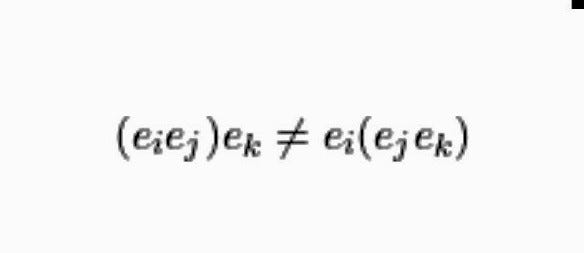
(eᵢeⱼ)eₖ ≠ eᵢ(eⱼeₖ)
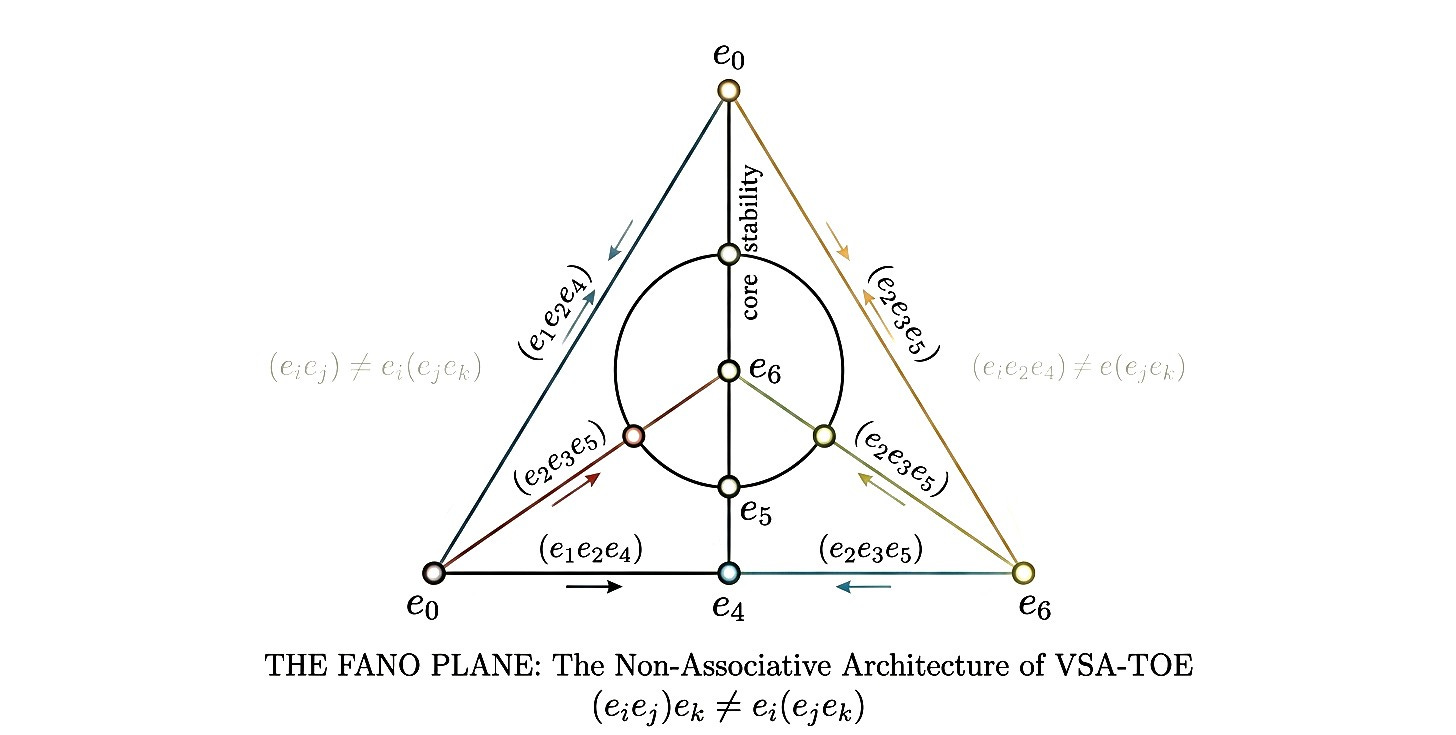
This is the defining property of the octonions; the 8-dimensional number system discovered by John Graves just months after Hamilton’s walk across Broom Bridge.
In standard algebra, the grouping of operations doesn’t matter. Multiply A by B, then by C, and you get the same result as multiplying A by the product of B and C. This is associativity; the mathematical rigidity that makes quaternions reliable for solid-body calculations.
The octonions break this rule. In 8 dimensions, the order of operations changes the result. What looks like a flaw is actually a degree of freedom.
When a physical system in 4D reaches a critical energy threshold; when the vortex tightens toward the point where the math would break, VSA-TOE proposes that the system transitions into octonionic space. The energy that would concentrate into a singularity instead encounters the non-associative flexibility of the 8D manifold and redistributes.
The mechanism VSA-TOE identifies for this redistribution is the G2 Flipper.
The G2 Flipper
G2 is the automorphism group of the octonions; the set of symmetry operations that govern how the eight dimensions interact while preserving the octonionic structure. It is the smallest of the exceptional Lie groups and one of the most geometrically elegant structures in mathematics.
In VSA-TOE, G2 functions as an active redistribution mechanism. The octonions are organized according to the Fano Plane, a geometric structure of seven imaginary units connected by seven triads. When energy in a 4D system approaches a blow-up threshold, the G2 symmetry performs what VSA-TOE considers a non-local inversion: it flips the informational load across the seven pillars of the Fano Plane, preventing any single point from accumulating infinite values.
The fluid doesn’t blow up because the universe has a higher dimensional pressure release valve.
Hamilton found the four leaf clover of associative reality; the math of the solid world. The octonions provide the seven leaf extension that keeps the fluid world from tearing itself apart.
Why We Don’t See It
If the stability of physical reality depends on 8D non-associative mathematics operating beneath the surface, why does our experience feel strictly 4D?
VSA-TOE’s answer is that the brain functions as a biological transducer.
A transducer converts one type of signal into another. The raw informational structure of the universe; high bandwidth, non-associative, operating across eight dimensions is more than any biological organism can process in real time. To function, the brain performs a continuous down sampling operation. It filters the 8D instruction set and reconstructs it as a stable, linear, 4D experience.
What we call reality is the output of this reconstruction. We don’t perceive the G2 flipper operating at the quantum level any more than we perceive the individual frames of a film. We perceive the result: smooth coffee, stable bridges, a world that holds together.
Hamilton’s experience on Broom Bridge was, in this reading, a moment where that filter briefly thinned. He sensed that 3D space was an incomplete signal and reached instinctively for the next level of the architecture. The equation he carved wasn’t just mathematics. It was a record of a human mind briefly touching the structure beneath the reconstruction.
The Open Question
The Navier-Stokes stability problem remains one of the deepest unsolved questions in mathematics precisely because the standard 4D framework doesn’t contain the tools to resolve it from within itself.
VSA-TOE proposes that those tools exist one dimension set higher, in the non-associative flexibility of octonionic algebra, governed by the G2 symmetry group, operating as a global stabilizer across a 12D superfluid manifold.
The coffee stays smooth. The bridge stands firm. The vortex dissipates without tearing the fabric of space.
The question worth debating is whether the mathematical architecture VSA-TOE identifies: G2 automorphisms acting as a non-local relief valve across the Fano Plane represents the mechanism responsible.
Hamilton crossed the Bridge. The Chisel is in your Hands.
Hamilton’s Limit: From Quaternions to Non-Associative Manifolds
D'Artagnan
VSA-TOE (Vector Synthesis Algorithm) is the model of reality developed over decades of research by Cognitive Origin. This piece was developed in collaboration with AI research partners: Full mathematical treatment is available across the VSA-TOE Substack and KDP library.